
One of the most common questions we hear from commercial building owners and facility managers is:
“At what point should I stop repairing this HVAC unit and replace it?”
Unfortunately, there isn’t one specific age when an HVAC system suddenly becomes too old to repair. A 15-year-old rooftop unit that has been well maintained may still have years of useful life remaining, while another unit of the same age may be experiencing repeated compressor, coil, motor, and control failures.
The better question is: Does it still make financial sense to invest in this equipment?
Age Is Important — But It Isn’t Everything
Most commercial HVAC equipment has an expected service life, but that doesn’t mean a unit automatically needs to be replaced when it reaches that age. We’ve performed some near miracles when it comes to repairing ancient units. But the question becomes what is the value to YOU and what are YOUR goals. Here are some things to think about…
A well-maintained system may operate reliably beyond its expected lifespan. However, once equipment gets into the 15–20+ year range, repairs should generally be evaluated more carefully.
Before approving another significant repair, consider the unit’s:
- Age and overall condition
- Repair history
- Maintenance history
- Availability and cost of replacement parts
- Refrigerant type
- Energy efficiency
- Reliability
- Importance to building operations
- Estimated cost of replacement
A relatively inexpensive repair on an older unit can still make perfect sense. Spending thousands of dollars on a major repair may be a different story.
Look at What You’ve Spent — Not Just Today’s Repair
A $2,000 repair may not sound unreasonable compared with replacing an entire rooftop unit. But what if you’ve already spent $7,000 repairing that unit over the last two years? This is where many building owners get caught in the repair cycle. Each individual repair seems reasonable, but collectively the building may be investing a substantial amount of money into equipment that continues to deteriorate.
When evaluating an older HVAC system, look at the total repair and maintenance costs over the previous two or three years, not simply the repair currently in front of you.
Consider What You’re Repairing and What’s Left to Repair
Not all repairs should carry the same weight. Replacing a belt, contactor, capacitor, sensor, or relatively inexpensive motor generally makes good sense. However, major component failures deserve more consideration.
For example, if an older unit needs a compressor, condenser coil, evaporator coil, heat exchanger, major control system, or multiple expensive components, it may be time to compare the repair cost with replacement.
You should also consider what remains original.
Replacing a compressor doesn’t make the rest of a 20-year-old unit new. You may now have a new compressor operating alongside an aging evaporator coil, condenser coil, blower assembly, heat exchanger, electrical components, and controls. A reputable HVAC contractor should be providing you with “real-talk” about what your repair options are and the risks associated with them.
Refrigerant Can Change the Equation
The refrigerant used by older equipment can also affect the repair-versus-replace decision. As refrigerants are phased down or become less readily available, their cost can increase and servicing older equipment may become more difficult.
A refrigerant leak on an aging system should therefore be evaluated carefully. Repairing one leak doesn’t necessarily mean another section of the system won’t develop a leak later.
When significant refrigerant repairs are required, it may make sense to compare the cost of repairing the existing equipment with upgrading to equipment using a current refrigerant.
Reliability Has a Value
Repair cost isn’t the only cost associated with aging HVAC equipment. Consider what happens when the unit fails.
For an office, a temporary HVAC outage may be inconvenient. For a restaurant, healthcare facility, server room, production area, refrigerated space, or other critical operation, equipment failure can become considerably more expensive.
If an aging unit has become unpredictable, replacement may be worthwhile even when individual repairs still appear financially reasonable.
Reliability itself has economic value.
Energy Costs Matter Too
Older equipment may also consume significantly more energy than modern HVAC systems.
Efficiency improvements alone don’t always justify replacing functioning equipment. But when you’re already considering a major repair, energy consumption should be included in the calculation.
The decision isn’t simply:
Repair cost vs. replacement cost.
It is closer to:
Repair cost + future repairs + energy costs + downtime risk vs. replacement cost + expected operating costs.
That provides a much more realistic comparison.
So, When Is an HVAC Unit Too Old to Repair?
There isn’t a universal cutoff, but once commercial HVAC equipment approaches approximately 15 years old, we recommend becoming increasingly selective about major investments.
At 20 years or older, substantial repairs should generally trigger a serious replacement discussion.
That doesn’t mean every 20-year-old unit should immediately be replaced. If the equipment is in good condition and needs a relatively minor repair, keeping it operational may still be the most economical choice. We’ve serviced equipment over 40 years old that is still running reliably.
The goal isn’t to replace equipment simply because it’s old.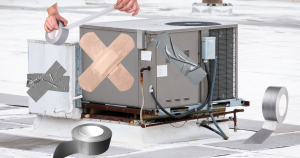
The goal is to avoid putting good money into equipment when the expected return on that investment no longer makes sense.
A Reputable HVAC Contractor Should Give You Both Options
When we identify a major problem with older equipment, we believe customers should have enough information to make an informed decision.
Depending on the condition of the system, that may mean providing:
Option 1: Repair the existing equipment
and
Option 2: Replace the equipment
We can then discuss the expected remaining life of the system, repair history, reliability concerns, efficiency, parts availability, and budget.
Sometimes repairing the existing unit is clearly the right decision. Sometimes replacement is clearly the better investment.
And sometimes there isn’t a perfect answer — but understanding the costs and risks of both options makes the decision considerably easier.
Not Sure Whether to Repair or Replace?
If you have aging commercial HVAC equipment and aren’t sure whether another repair makes financial sense, Advance Air can evaluate the condition of the system and help you compare your options.
Our goal is to help you determine where continued investment makes sense — and where it may be time to start planning for replacement.